

Anker SOLIX C1000 Gen 2
Best for weekend camping with a cool box, and short power cuts, and keeping a router or PC running as a UPS.
We compare the Jackery Explorer 500 and the EcoFlow RIVER 2 Pro across every dimension that matters - our scores, the key specs, and how each performs on the things you will actually notice day to day.
| Jackery Explorer 500 | EcoFlow RIVER 2 Pro | |
|---|---|---|
| Our score | 9.2/10 | 8.4/10 |
| Best for | day trips, camping lights and charging laptops and phones | weekend camping with a cool box, and short power cuts |
| Not ideal for | running a full-size kettle, electric heater or other high-power appliance | running a full-size kettle, electric heater or other high-power appliance |
| Brand | Jackery | EcoFlow |
| Jackery Explorer 500 | EcoFlow RIVER 2 Pro | |
|---|---|---|
| Capacity | 518Wh | 768Wh |
| AC output | 500W continuous, 1,000W surge | 800W continuous |
| Battery | Not listed | LiFePO4 |
| Solar input | Up to 100W | Up to 220W |
| Weight | 6kg | 7.8kg |
The Jackery stores 518Wh, so allowing about 15% for conversion losses it could run a 60W laptop for roughly 7 hours or a 40W compressor cool box for about 11 hours.
The EcoFlow stores 768Wh, so allowing about 15% for conversion losses it could run a 60W laptop for roughly 11 hours or a 40W compressor cool box for about 16 hours.
The Jackery delivers 500W continuously, with up to 1,000W surge for start-up, so it can run a TV, a fridge or small power tools, but not kettles, heaters or microwaves.
The EcoFlow delivers 800W continuously, so it can run a TV, a fridge or small power tools, but not kettles, heaters or microwaves.
The Jackery accepts up to 100W of solar input, so a full charge from panels takes roughly 7.5 hours of strong sunshine at full panel output, and longer on a typical UK day.
The EcoFlow accepts up to 220W of solar input, so a full charge from panels takes roughly 5 hours of strong sunshine at full panel output, and longer on a typical UK day.
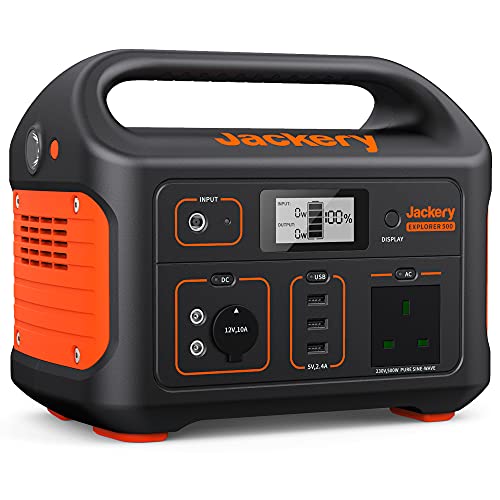
Inside the Jackery sits a lithium-ion battery with a 518Wh capacity, and that capacity largely determines how much time it can run devices before it needs a recharge. The battery acts as the main energy store, so battery lifespan depends on how often it is fully cycled and how heat is managed. The unit includes temperature protection and protections for overcharge, short circuit, overcurrent, and overpower, which can help reduce unsafe electrical stress.
The EcoFlow uses LiFePO4 (lithium iron phosphate) cells, which last far longer than the 500 or so cycles typical of older lithium-ion power stations and are less prone to overheating.
The Jackery weighs about 6kg, so it is portable but best moved between car and pitch rather than carried far.
The EcoFlow weighs about 7.8kg, so it is portable but best moved between car and pitch rather than carried far.
Who is the Jackery for? It suits people who want a portable power station for outdoor use with solar panel charging, particularly RV-ers and campers. With a 518Wh capacity and a 230V 500W pure sine wave AC output (1000W surge peak), it fits common devices such as TVs, chargers, laptops and small appliances. It also supports car-related use via its 12V/10A and USB ports, which can power items like car coolers, vacuums and air pumps. Anyone asking whether the portable power station is any good should expect best results when driving moderate loads.
The EcoFlow is aimed at people who want portable power for day-to-day use. It suits camping trips, outdoor work, and power-loss backup for essentials at home, and it will appeal to shoppers searching for the portable power station best price UK who also want solar panel charging. With 768Wh of capacity and 800W rated output, it can run common electronics and charge multiple devices using its several outlet types. It offers 220W solar input for off-grid recharging, and weighs 7.8kg, which is reasonably manageable for transport, though it may feel heavy for long hikes.
Our pick is the Jackery Explorer 500 (our score 9.2/10) - A mid-range portable power station with 518Wh of storage and 500W of AC output. The EcoFlow RIVER 2 Pro is still worth it if it is cheaper when you check, or if it better matches your specific needs.
Best for weekend camping with a cool box, and short power cuts, and keeping a router or PC running as a UPS.

Best for day trips, camping lights and charging laptops and phones.