Anker SOLIX C300 Review UK 2026

Quick verdict
Score: 9.6/10
Best for: day trips, camping lights and charging laptops and phones
Not for: running a full-size kettle, electric heater or other high-power appliance
Bottom line: A mid-range portable power station with 288Wh of storage, 300W of AC output and long-life LiFePO4 cells.
The Anker SOLIX C300 (A1722) is a compact portable power station built around a 288Wh LiFePO4 battery and a 300W rated output (600W surge peak), designed to run a range of small devices and tools without mains power. The quick verdict is mixed but clear: it suits phones, laptops, lights, and small appliances, while it is not positioned as a heavy-duty generator. It recharges via wall outlet, car, or PD USB-C, and supports solar input of up to 100W, so whether it is worth buying comes down to charging needs rather than size.
Key facts
- The Anker SOLIX C300 stores 288Wh, so allowing about 15% for conversion losses it could run a 60W laptop for roughly 4 hours or a 40W compressor cool box for about 6 hours.
- It delivers 300W continuously, with up to 600W surge for start-up, so it can run laptops, lights, fans and phones rather than kitchen appliances.
- It accepts up to 100W of solar input, so a full charge from panels takes roughly 4 hours of strong sunshine at full panel output, and longer on a typical UK day.
- It uses LiFePO4 (lithium iron phosphate) cells rated for 3,000 charge cycles, which last far longer than the 500 or so cycles typical of older lithium-ion power stations and are less prone to overheating.
- It weighs about 4.1kg, so it is easy to carry to a tent or a picnic.
Taken from the manufacturer's Amazon UK listing, checked 2026-11-09.
Key specifications
| Specification | Detail |
|---|---|
| Capacity | 288Wh |
| AC output | 300W continuous, 600W surge |
| Battery | LiFePO4, 3,000 cycles |
| Solar input | Up to 100W |
| Weight | 4.1kg |
| Dimensions | 16.4L x 16.1W x 24 |
Pros
- 288Wh capacity
- 300W rated output (600W surge peak)
- Long-life LiFePO4 battery
- Solar-ready (up to 100W solar input)
Cons
- Solar panel usually sold separately
- Not a substitute for whole-home backup
Not sure the Anker SOLIX C300 is right for you? Alternatives to consider
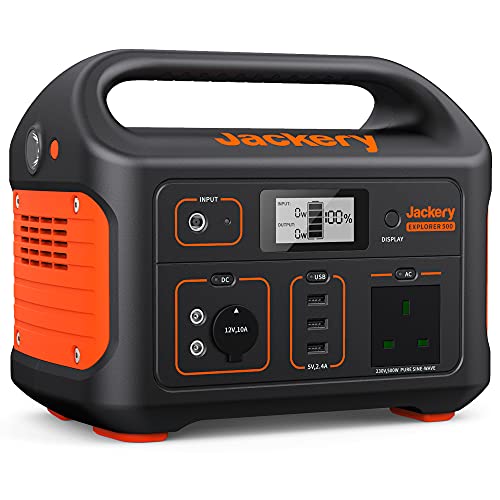
Jackery Explorer 500
Best for day trips, camping lights and charging laptops and phones.

Vtoman Jump 600X
Best for day trips, camping lights and charging laptops and phones.

EcoFlow RIVER 2 Max
Best for day trips, camping lights and charging laptops and phones.
Capacity and What It Powers
The Anker stores 288Wh, so allowing about 15% for conversion losses it could run a 60W laptop for roughly 4 hours or a 40W compressor cool box for about 6 hours.
With a 288Wh LiFePO4 battery, this portable power station (model A1722) is designed for common electronics rather than heavy mains appliances all day. It can supply up to 300W rated power, with a 600W surge peak, so short starting loads may be possible, whereas continuous high-draw devices may drain the battery quickly. This makes it suitable for phones, tablets, laptops, small fans and other travel gear where power demand is spread across the day. For longer sessions, pairing the Anker with a 100W solar panel can help maintain charge, depending on conditions.
Output and Ports
The Anker delivers 300W continuously, with up to 600W surge for start-up, so it can run laptops, lights, fans and phones rather than kitchen appliances.
Output on the portable power station (model A1722) is rated at 300W, and it supports a 600W surge peak for short bursts. The ports shape day-to-day versatility. The unit includes 2x AC outlets rated at 300W, a 120W car socket, two USB-C outputs rated up to 140W, plus a 15W USB-C and a 12W USB-A. For mixed charging, devices can share power, though peak demand may still reduce runtime.
Recharging and Solar
The Anker accepts up to 100W of solar input, so a full charge from panels takes roughly 4 hours of strong sunshine at full panel output, and longer on a typical UK day.
Recharging the Anker (A1722) is designed for several common scenarios, so the charging method can be matched to where the unit is being used. In the portable power station experience, it supports fast wall charging to reach 80% in about 50 minutes. It can also be topped up via a car socket, or through the PD 3.1 USB-C port, although the timing depends on the charging source. For solar use, the Anker SOLIX C300 solar generator approach supports up to 100 W input and works best with the Anker W solar panel. It is not compatible with SOLIX PS30 or other 5 V~3 A USB-C solar panels.
Battery Type and Lifespan
The Anker uses LiFePO4 (lithium iron phosphate) cells rated for 3,000 charge cycles, which last far longer than the 500 or so cycles typical of older lithium-ion power stations and are less prone to overheating.
Built around a LiFePO4 (lithium iron phosphate) battery, the portable power station (A1722) is designed for long service life rather than short-term peak output. The pack is rated for 3,000+ cycles, and the manufacturer also claims 10 years of power. The Anker pros and cons primarily come down to durability versus gradual capacity wear over repeated charging. For day-to-day recharging, it can be topped up via wall, car, or PD 3.1 USB-C, which helps users manage cycle counts.
Portability and Build
The Anker weighs about 4.1kg, so it is easy to carry to a tent or a picnic.
Even with its powerful 300 W class output, the portable power station (A1722) is built to remain transport-friendly. It weighs 4.1 kg and measures 16.4 x 16.1 x 24 cm (L x W x H), helping it fit in car boots and travel bags. At the same time, the 4.1 kg weight is still awkward for one-handed carrying. Build and handling are travel-oriented, with impact resistance and quiet operation rated at 25 dB at 3.3 ft. Carrying uses included support points for straps.
Who Is This Power Station For?
Who is this portable power station (A1722) aimed at, and where does it make the most sense to use it? It is designed for people who want a compact, lightweight backup, or a travel-ready power bank for everyday devices. With a 288Wh capacity and up to 300W AC output (600W surge), it is suited to running phones, laptops, small lights and some small appliances, particularly for short trips and outings where portability matters. It also fits the use case behind searches such as "best portable power station uk", focusing on convenient, on-the-go charging.
Where to Buy in the UK
For people in the UK comparing portable options, the Anker (A1722) is typically searched for through major retailers that sell Anker's SOLIX range, with some accessory-focused sellers also listing the matching 100W solar panel for solar charging. Buyers commonly compare anker solix c300 listings online for the lowest price, but stock availability and bundle contents can vary, and pricing can change. For fast browsing, anker solix c300 on Amazon UK is common, and delivery times vary by seller and location. It is important to confirm the listing is specifically the A1722 model, and that any solar panel offered matches the C300's requirements.
Frequently Asked Questions
What can the Anker SOLIX C300 power?
The Anker SOLIX C300 stores 288Wh, so allowing about 15% for conversion losses it could run a 60W laptop for roughly 4 hours or a 40W compressor cool box for about 6 hours. With 288Wh capacity and 300W rated output, the portable power station suits phones, laptops, lights and small devices. Match the device wattage to the station's rated output before relying on it.
How long will this portable power station last?
The Anker SOLIX C300 stores 288Wh, so allowing about 15% for conversion losses it could run a 60W laptop for roughly 4 hours or a 40W compressor cool box for about 6 hours. Roughly, runtime = 288Wh minus around 10-15% conversion loss, divided by the device's watts. A 60W device on this station runs for several hours; a high-watt appliance drains it far faster.
Can you recharge the Anker with solar?
Yes - The portable power station accepts up to 100W solar input from a compatible panel (usually sold separately), which is what makes it a "solar generator" for off-grid and power cuts.
What battery does the Anker use and how long will it last?
The Anker SOLIX C300 stores 288Wh, so allowing about 15% for conversion losses it could run a 60W laptop for roughly 4 hours or a 40W compressor cool box for about 6 hours. The portable power station uses a LiFePO4 battery (long lifespan, 3000+ cycles typical). LiFePO4 cells typically keep 80% capacity after 3000+ charge cycles - roughly ten years of regular use - and are safer and more stable than older lithium-ion.
Is the Anker SOLIX C300 good for power cuts and camping?
This portable power station is well suited to camping, caravans and as backup during power cuts. For whole-home backup you would need a far larger unit and proper switchover, so treat it as essentials backup.
Is the Anker worth it?
If you camp, face power cuts, or want quiet portable power, the portable power station earns its place for its 288Wh capacity. Check the current Amazon UK price, as power stations are heavily discounted around Prime Day and Black Friday.